Swatch 3
Tapestry techniques
In tapestry, the weft doesn't travel all the way across the loom. Each colour is woven back and forth only where it's needed, building shapes like a painter builds areas of colour. A handful of techniques let you join, blend and texture those shapes.
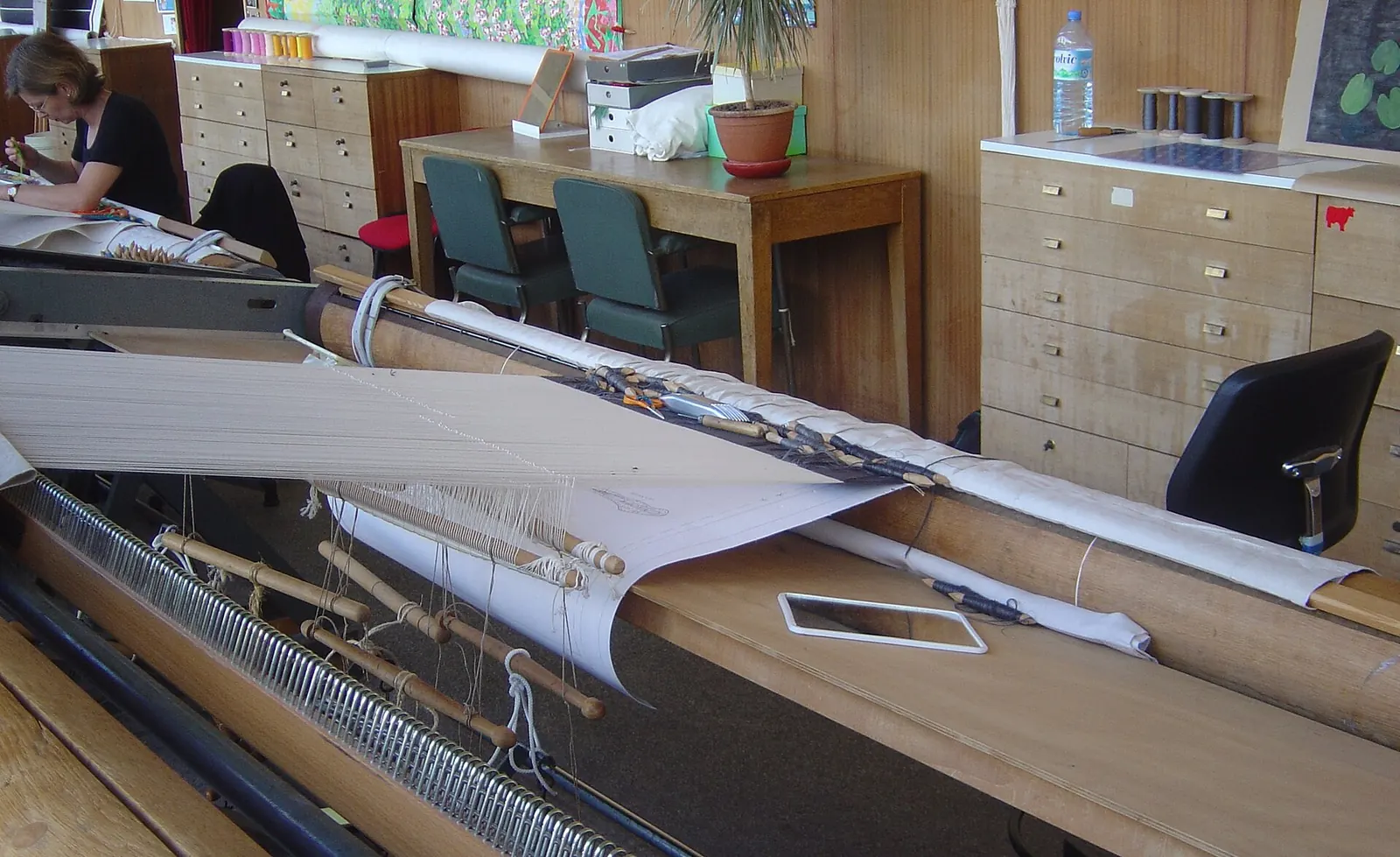
Weft-faced weaving
Tapestry is weft-faced: the weft is beaten down so densely that it completely hides the warp. That's why warps are spaced a little wider and the weft is laid generously. The image you see is made entirely of weft.
Joining colours
| Technique | How | Use |
|---|---|---|
| Slit | Two colours turn back around neighbouring warps | Crisp vertical edges; long slits can be sewn closed |
| Interlock | The wefts loop around each other between warps | Closes the gap, with a slightly softer line |
| Dovetail | Both colours turn around the same warp | A serrated, toothed join |
| Hatching | Rows of two colours alternate in staggered lengths | Shading and blending |
| Pick and pick | Two colours alternate every row | Fine vertical stripes |
Diagonals are easiest. Shapes with gentle slopes build smoothly. Steep diagonals and vertical edges need slits or joins, and curves need care to avoid steps.
Texture: soumak and rya
Soumak wraps the weft around the warps, forward over two and back under one, making a raised line that looks like a braid. It's often used for outlines and borders.
Rya knots make a shaggy pile. Short lengths of yarn are knotted around pairs of warps with the ends hanging down the front, and each row of knots is locked in with a few rows of plain weave. They're popular for fringes and textured wall hangings.
Following a design
Traditional tapestry weavers work from a full-size drawing called a cartoon. On a low-warp loom, it sits under the warp; on a high-warp (upright) loom, its main lines are inked onto the warp itself. Because the weaver usually works from the back of the tapestry, designs are often reversed. For a frame loom, simply draw your design on paper, place it behind the warp, and mark key lines on the warps with a fine marker.
Great tapestry traditions
Tapestry has been woven in many cultures, from ancient Egypt and the Andes to medieval Europe and kilim weaving across Anatolia, Central Asia and North Africa. In France, the workshops of the Gobelins in Paris and of Aubusson became famous for tapestries woven on high-warp and low-warp looms respectively. Contemporary weavers use the same techniques for abstract and graphic designs.
Common mistakes
| Mistake | Fix |
|---|---|
| Building one shape too high first | Build areas up together so the warps stay evenly spaced |
| Warp showing between rows | Lay more weft and beat more firmly |
| Long slits gaping | Interlock, dovetail or sew the slit closed afterwards |
| Rya rows sliding | Weave at least two or three plain rows between each row of knots |
Designing your first tapestry
- Keep the design simple: a few bold shapes, such as hills, a sun and a sky, teach every technique on this page.
- Limit the palette to four or five colours, with two shades of one colour to try hatching.
- Weave a small sample first to check that your weft covers the warp at your chosen spacing.
- Leave a margin of plain weave at the sides to keep the edges straight.
Turn it round. Many weavers turn their design sideways, so that tall shapes become wide ones that are easier to weave without long slits.
Questions weavers ask
What yarn is best for tapestry?
Smooth wool weft on a strong cotton or linen warp is traditional. Wool packs down well and has a natural spring.
Can I use leftover knitting yarn?
Yes, especially for experimenting. Very stretchy or slippery yarns are harder to control, so mix them with smoother ones.